The Promise of Human Pluripotent Stem Cells
Human pluripotent stem cells have fundamentally changed what is possible in biomedical research. Their capacity to self-renew indefinitely while retaining the potential to differentiate into any human cell type makes them a powerful platform for biological studies. Since Thomson et al. first described the derivation of hESCs in 1998, and Yamanaka’s landmark reprogramming work in 2006 opened the door to patient-specific hiPSCs, the range of applications has expanded continuously.
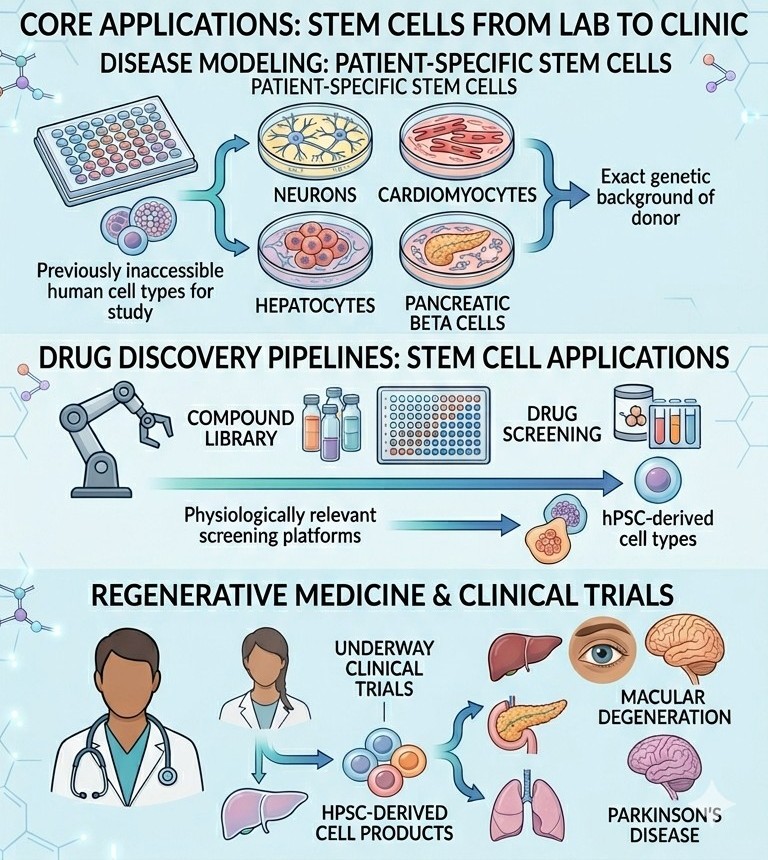
Disease modeling using patient-derived hiPSCs has given researchers access to human cell types previously inaccessible for in vitro study — neurons, cardiomyocytes, hepatocytes, pancreatic beta cells — carrying the exact genetic background of the donor. Drug discovery pipelines increasingly incorporate hPSC-derived cells as more physiologically relevant screening platforms. In regenerative medicine, clinical trials using hPSC-derived cell products are now underway for conditions ranging from macular degeneration to Parkinson’s disease.
The scientific and therapeutic potential is not in question. What has proven far harder is translating that potential into experimental and manufacturing reality — and much of the difficulty traces back to a single, underappreciated problem: reproducibility.
The Reproducibility Problem in hPSC Culture
hPSCs are exquisitely sensitive to their environment. Minor perturbations in coating quality, media composition, passaging technique, or incubator conditions can trigger spontaneous differentiation, alter proliferation kinetics, or gradually shift the epigenetic state of a culture in ways that may not be immediately visible but will compromise downstream experiments. Reproducibility — within a lab, between labs, and across timepoints — remains one of the most persistent and costly challenges in the field.
This sensitivity is not a flaw in the cells; it is an intrinsic property of pluripotency. The pluripotent state is inherently unstable, maintained by a tightly balanced transcriptional and signaling network. In vivo, this network is supported by a precisely defined niche — specific cellular neighbors, matrix contacts, and paracrine signals. In vitro, the researcher must reconstruct that niche artificially, and every component of the reconstruction introduces a potential source of variability.
The Extracellular Matrix: A Critical and Often Overlooked Variable
Of all the variables in an hPSC culture system, the extracellular matrix (ECM) coating is among the most consequential and least carefully scrutinized. The ECM is not a passive adhesion substrate. ECM proteins present ligands that engage specific integrins on the cell surface, triggering intracellular signaling cascades that influence proliferation, survival, and fate decisions. For hPSCs, integrin engagement — particularly through αvβ3 and αvβ5, which recognize vitronectin, and α6β1/α6β4, which bind laminin — plays a direct role in sustaining the self-renewal machinery. The choice of ECM coating is therefore not merely operational; it has mechanistic consequences for the cells being cultured.
Why Matrigel Falls Short
Matrigel — a solubilized basement membrane extract from Engelbreth-Holm-Swarm mouse sarcoma — became the default hPSC coating largely through historical availability and empirical familiarity rather than scientific optimality. It works, but its limitations are structural and cannot be engineered away.
Because Matrigel is a complex biological extract rather than a defined product, its composition varies between lots. The relative proportions of its major components — laminin-111, collagen IV, entactin, heparan sulfate proteoglycans, and co-purified growth factors including EGF, bFGF, IGF-1, and TGF-β — are not controlled. Researchers working with a new lot are, in a meaningful sense, working with a partially different reagent. The practical consequences are well-known:
- Lot-to-lot variability requiring re-titration of coating concentration and empirical re-qualification of culture conditions with each new batch
- Unpredictable spontaneous differentiation events that correlate with lot changes and resist straightforward mechanistic explanation
- Embedded growth factors at unknown concentrations that confound experiments designed to interrogate specific signaling pathways
- Animal-derived origin introducing xeno-contamination concerns incompatible with clinical-grade manufacturing and increasingly problematic for regulatory submissions
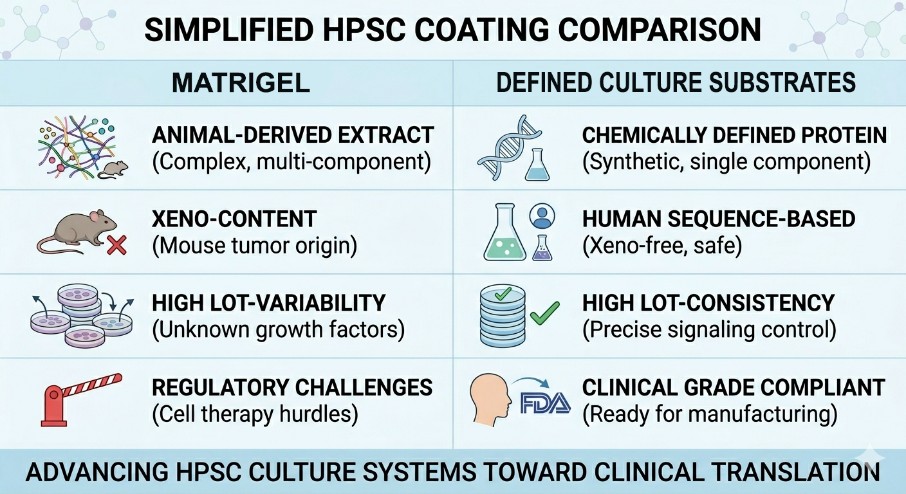
As hPSC research has matured and the field has moved toward clinical translation, these limitations have become less acceptable. The demand for defined, reproducible, and xeno-free culture systems has grown accordingly — and recombinant vitronectin has emerged as one of the most scientifically well-grounded alternatives.
Why Vitronectin Is a Rational Choice
Vitronectin is a glycoprotein naturally present in serum and the extracellular matrix. Its relevance to hPSC culture is not empirical serendipity but mechanistic logic: hPSCs express high levels of αvβ3 and αvβ5 integrins, both of which engage the RGD motif in vitronectin with high affinity. This integrin-ECM interaction activates downstream signaling through focal adhesion kinase (FAK) and PI3K/Akt pathways that support cell survival and proliferation in the absence of feeder cells.
As a single, defined recombinant protein, vitronectin eliminates the compositional complexity of Matrigel while preserving the specific integrin-engagement signals that hPSCs require. It presents no undefined growth factors, no batch-variable proteoglycans, and no animal-derived components. The result is a coating whose biological activity is consistent by design rather than by lot-qualification luck (Figure 1).
From a practical standpoint, recombinant vitronectin is compatible with standard tissue culture-treated plates without specialized surface chemistry, and works across multiple chemically defined media formulations. For labs building culture systems that need to be reproducible, transferable, or eventually GMP-compatible, these properties matter as much as the biological performance data.
Performance in Long-Term Culture
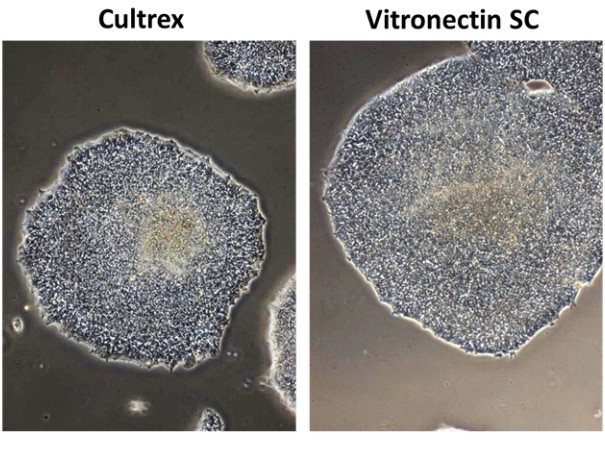
A direct comparison illustrates the practical performance of recombinant vitronectin. H9 hESCs maintained on vitronectin-coated plates (10 μg/mL) for 30 passages retain the compact, high-density colony morphology characteristic of undifferentiated hPSCs — indistinguishable from, and arguably more uniform than, cells maintained on Cultrex under equivalent conditions (Figure 1). Molecular characterization confirmed concordant high-level expression of the core pluripotency transcription factors Oct4, Sox2, and Nanog at passage 30, indicating that the full pluripotency network remains intact after extended culture on a defined vitronectin surface (Figure 2).
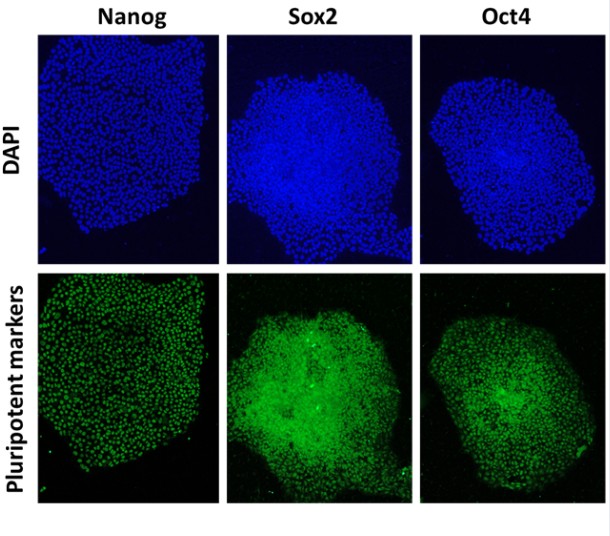
These results are representative of the performance observed across multiple experiments and passaging cycles, demonstrating that the colony morphology and pluripotency marker expression maintained on a defined vitronectin surface are stable and consistent rather than incidental findings.
A Field in Transition
The shift toward defined, xeno-free hPSC culture is not a preference of the fastidious; it reflects where the field is going. Regulatory frameworks for advanced therapy medicinal products (ATMPs) increasingly require that every component of a manufacturing process be characterized, consistent, and free of adventitious agents. Undefined biological matrices face a fundamental challenge in this environment: their variability cannot be specified away.
Beyond the regulatory argument, there is a simpler scientific one. Defined systems produce more interpretable data. When the matrix is a single characterized protein rather than a complex biological extract, observations about cell behavior can be attributed more confidently to the variables under study rather than to unknowns in the baseline environment. In a field where reproducibility is already a recognized problem, that clarity has real value.
The transition away from Matrigel will not happen overnight, and in many basic research contexts its use remains perfectly defensible. But for groups building platforms intended to scale, to transfer between sites, or to feed into translational pipelines, the case for defined alternatives like recombinant vitronectin is now well-supported by both mechanistic rationale and experimental evidence. The tools exist; the question is whether labs are ready to use them.
Further information: ScienCell’s recombinant human Vitronectin SC (Cat. No. MB9138) is available.