Cardiac fibroblasts (CF) provide structural support for cardiac myocytes and are responsible for extracellular matrix synthesis in the heart during growth and pathophysiological conditions. CF are an important cellular component of myocardial responses to injury and the source of paracrine growth factors. CF proliferation and synthesis of matrix is essential for scar formation at sites of myocardial infarction and cardiac fibrosis. CF cultures have been widely used as a model to study the cardiac matrix remodeling by physiological (exercise) and pathological (hypertension) stressors.
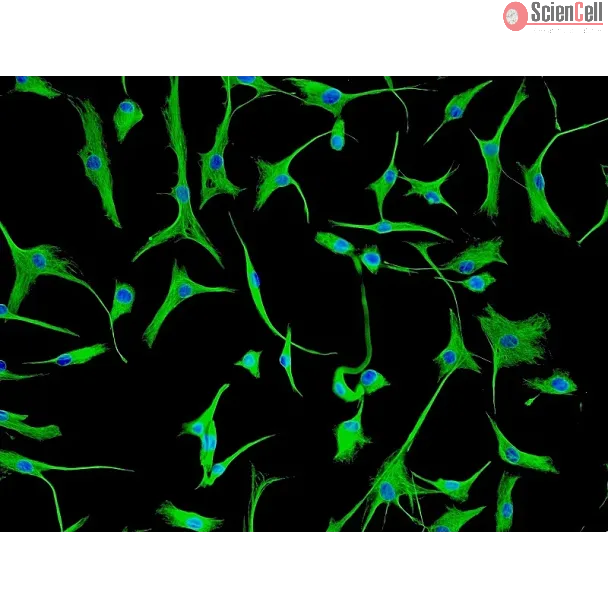
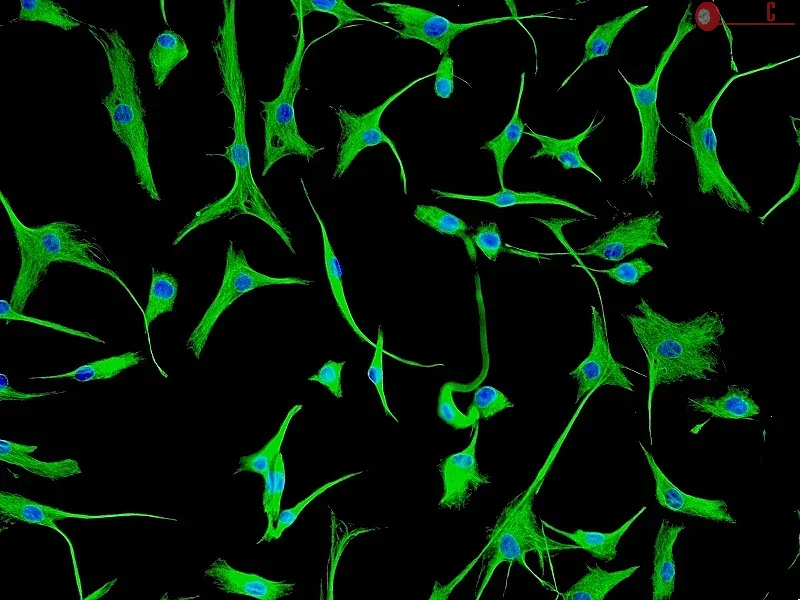
HCF-a from ScienCell Research Laboratories are isolated from human adult heart. HCF-a are cryopreserved at passage one and delivered frozen. Each vial contains >5 x 10⁵ cells in 1 ml volume. HCF-a are characterized by immunofluorescence with antibody specific to fibronectin. HCF-a are negative for HIV-1, HBV, HCV, mycoplasma, bacteria, yeast, and fungi. HCF-a are guaranteed to further expand for 15 population doublings under the conditions provided by ScienCell Research Laboratories.
Recommended Medium
It is recommended to use Fibroblast Medium-2 (FM-2, Cat. #2331) for culturing HCF-a in vitro.
心脏成纤维细胞(CF)为心肌细胞提供结构支持,并在心脏生长以及病理生理状态下负责细胞外基质的合成。CF 是心肌损伤反应中的重要细胞组成部分,也是旁分泌生长因子的来源。CF 的增殖以及基质合成对于心肌梗死部位的瘢痕形成和心脏纤维化至关重要。CF 培养物已被广泛用于研究由生理性(运动)和病理性(高血压)应激因素引起的心脏基质重塑。
ScienCell Research Laboratories 提供的人源成人心脏成纤维细胞(HCF-a)分离自人源成人心脏组织。HCF-a 以第 1 代细胞进行冻存,并以冷冻状态运输。每瓶含有超过 5 x 10⁵ 个细胞,体积为 1 ml。HCF-a 经采用针对纤连蛋白的特异性抗体进行免疫荧光鉴定。HCF-a 经检测为 HIV-1、HBV、HCV、支原体、细菌、酵母菌和真菌阴性。根据 ScienCell Research Laboratories 提供的培养条件,HCF-a 可保证进一步扩增 15 个群体倍增周期。
推荐培养基
建议使用成纤维细胞培养基-2(FM-2,产品编号 #2331)对 HCF-a 进行体外培养。
Product Sheets
 6330
6330
Search for a Certificate of Analysis by Lot Number below:
For healthspan and lifespan, ERK, AMPK and mTORC1 represent critical pathways and inflammation is a centrally important hallmark1,2,3,4,5,6,7. Here we examined whether IL... More
For healthspan and lifespan, ERK, AMPK and mTORC1 represent critical pathways and inflammation is a centrally important hallmark1,2,3,4,5,6,7. Here we examined whether IL-11, a pro-inflammatory cytokine of the IL-6 family, has a negative effect on age-associated disease and lifespan. As mice age, IL-11 is upregulated across cell types and tissues to regulate an ERK–AMPK–mTORC1 axis to modulate cellular, tissue- and organismal-level ageing pathologies. Deletion of Il11 or Il11ra1 protects against metabolic decline, multi-morbidity and frailty in old age. Administration of anti-IL-11 to 75-week-old mice for 25 weeks improves metabolism and muscle function, and reduces ageing biomarkers and frailty across sexes. In lifespan studies, genetic deletion of Il11 extended the lives of mice of both sexes, by 24.9% on average. Treatment with anti-IL-11 from 75 weeks of age until death extends the median lifespan of male mice by 22.5% and of female mice by 25%. Together, these results demonstrate a role for the pro-inflammatory factor IL-11 in mammalian healthspan and lifespan. We suggest that anti-IL-11 therapy, which is currently in early-stage clinical trials for fibrotic lung disease, may provide a translational opportunity to determine the effects of IL-11 inhibition on ageing pathologies in older people. Less
Due to tumor heterogeneity, most believe that effective treatments should be tailored to the features of an individual tumor or tumor subclass. It is still unclear, howev... More
Due to tumor heterogeneity, most believe that effective treatments should be tailored to the features of an individual tumor or tumor subclass. It is still unclear, however, what information should be considered for optimal disease stratification, and most prior work focuses on tumor genomics. Here, we focus on the tumor microenvironment. Using a large‐scale coculture assay optimized to measure drug‐induced cell death, we identify tumor–stroma interactions that modulate drug sensitivity. Our data show that the chemo‐insensitivity typically associated with aggressive subtypes of breast cancer is not observed if these cells are grown in 2D or 3D monoculture, but is manifested when these cells are cocultured with stromal cells, such as fibroblasts. Furthermore, we find that fibroblasts influence drug responses in two distinct and divergent manners, associated with the tissue from which the fibroblasts were harvested. These divergent phenotypes occur regardless of the drug tested and result from modulation of apoptotic priming within tumor cells. Our study highlights unexpected diversity in tumor–stroma interactions, and we reveal new principles that dictate how fibroblasts alter tumor drug responses. Less
ScienCell Research Laboratories (SRL) takes pride in being a resource for researchers all over the world. The publications listed here are not meant as an endorsement or confirmation of the reliability of the products.